This is sooo cool. I used to know this deaf guy called Ed who would come raving with us because he could feel the music and for a few hours could be lost in the crowd of us hearing people and we would all be experiencing the same thing.
Club nights for the deaf and hard of hearing are growing in popularity. How do they work?
Thumping bass. Throbbing beats. Music so loud it can be physically felt. Clubbers don’t need to use their ears to get a feel for the music – the dance floor experience can be picked up through the rumble of a pumped-up bass line.
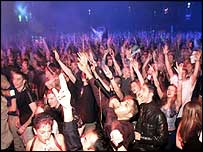
On Saturday about 900 clubbers turned out for a deaf rave at the Rocket club in north London, the fourth event in the past year run by Troi Lee, who was born profoundly deaf.
And on Wednesday night, Radio 1’s Gilles Peterson is among the DJs who will take to the decks at Deaf Jam, a one-off club night to raise money for deaf charities.
How do these events differ from a regular club night? Volume, says organiser James Hoggarth.
“The volume may be pushed a little further and the bass turned up to 11 so the purpose of the night can be truly be shared with the deaf and hard of hearing crowd.”
He first got the idea when he put his hands over his ears one night out clubbing, and realised that he could feel the music as strongly as he could hear it.
“My guts were literally shaking; you don’t need to hear to experience clubbing. So I’ve asked the DJs pick music with big chunky bass lines and heavy rhythmic tracks. Michael Jackson’s Billie Jean, which has a big panther of a bass line, is bound to get an airing; and one of my must-plays is LFO, a techno track from the early 90s famous for shattering club sound systems.”
The event will be held at Plastic People, an east London club renowned for its powerful sound system (and heavy duty sound insulation).
As the music gets louder and the vibrations get stronger, everyone cheers and dances
Deaf clubber Ashton Phillip, who went to the Easter Saturday rave, says the music is much louder than at regular club nights.
“You feel the music in your whole body. As it gets louder and the vibrations get stronger, everyone cheers and dances.
“The DJs played R ‘n’ B, rap, reggae and hip hop. Most deaf people couldn’t tell what kind of music was playing from these vibrations. Some thought it was rock when it was really R ‘n’ B because both feel like heavy music. But they loved the vibrations anyway.”
As at a regular club night, the lighting changes colour to reflect the music. The stage, too, is more brightly lit so that deaf clubbers can see the performers signing on stage. At Saturday’s rave, these included a deaf Australian comic, a rap contest using hand signals, and karaoke in which soloists signed the lyrics to popular tracks.
“It would be hard for deaf people to have a good time without lighting,” Ashton says.
“Many deafies prefer to chat than to dance, but it was quite difficult to talk to each other – not much lighting on the dance floor, only on the stage. But it was a brilliant time.”
More info: Deaf Rave
 Yan Sham-Shackleton Online
What a great story. This is the first time I’ve ever heard of raves for the deaf/hard of hearing.
I’m also very proud that the rave was held in London!
My mother is deaf. She told that being deaf is not like living in a silent world, it’s more like standing next to a busy motorway all the time. I.e. lots of background noise that muffles everything else out.
LikeLike
I am glad you apreciated the post/story. It is such a fantastic idea espeically after what I learnt from being around Ed. I couldn’t communicate very well with him but when we were dancing, it didn’t matter, we shared a beat. I always thought that was nice.
I just can’t imagine not having my capacities and living in such a different world that is never catered to your needs. I would like to go to a rave like that.. it would be so fascinating to go into “their” world for once….but maybe it won’t be that different, can’t hear a word anyone is saying to you at a rave at anytime anyway. 🙂
Out of curiosity, does that mean you can sign??
Yan
LikeLike
No Yan, my mother suddenly turned deaf when she was 17 after an ear infection. She was young and therefore too self-concious to want to learn sign language. She learnt to lip-read instead.
She says that long before I was even one year old, I had already worked out that she couldn’t hear. Must have been the base survival instinct kicking-in. (Apparently) I never ever cried when only she was with me–only when my (hearing) father was there. I also used to throw things at her from my cot to get her attention.
She said that it was lucky I wasn’t strong enough to throw bricks.
Also, she bought a puppy when she was pregnant and the dog, too, quickly worked out that she couldn’t hear. When I slept, the dog always slept beside me and when I would wake up, the dog would run and wake/fetch my mother.
Pretty weird, huh?
Unfortunately, some people said that my mother, being deaf, should not be allowed to look after a baby. However, they were wrong, we coped just fine.
LikeLike
No, not wierd at all. Humans plus best animal friends are resourcful creatures that adapt to environment except the lame people who think your mom can’t look after you…. ergh.. So there we have it! Proof that crying as ways to get attention is a learned behavior. Should tell all my baby popping girlfriends about it right away! Pretend you can’t hear! Kids will stop screaming all day! Good to know. 😉
However, you did grow out of throwing things to get attention right? I mean that would be a bit of a pain in adult life. 😛
Yan
LikeLike
By the way, the biggest thing to change my mother’s life was, believe it or not, the beginning of television subtitles back in the 80’s.
In the UK, we have a service called “Teletext” where you can programme your TV to subtitle all the programmes. No doubt, everywhere has the same thing.
After years of looking at pictures on the screen suddenly she could watch the news and the soaps etc. For the first time she could go to work and take part in a conversation about the previous evenings TV programmes.
It’s quite a sobering experience to imagine living in a world where you can’t listen to music, watch TV, go to the cinema etc.
That’s why it felt fantastic to read the above story above raves for the deaf.
LikeLike
Ha ha, do I still throw things at people to get attention? Don’t be ridiculous…I haven’t done that for weeks.
LikeLike
“turned up to 11”
This Is Spinal Tap!
LikeLike
I really should see the movie one day. I always miss the jokes…
Yan
LikeLike
Hmmm… there was a link in there…
(this one: http://www.suntimes.com/ebert/greatmovies/spinal_tap.html)
LikeLike